The Duke Lemur Center (DLC) plays a central role in lemur conservation. Who knew that the second largest grouping of lemurs--other than Madagascar--lived right here in Durham, NC? With a captive population of almost 300 prosimians, the DLC sponsors research, a breeding program and educational programs to help people learn about Madagascar.
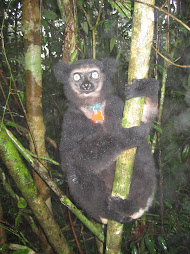
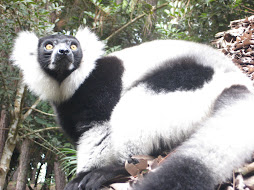
Duke helped to release 13 black-and-white ruffed lemurs back into the wild in Betampona Strict Nature Reserve (one of the sites that I will visit this summer) over 1997, 1998 and 2001. Some of these original lemurs have learned how to live, eat, and mate in the wilds of Madagascar.
Check out the story in this short video clip from Duke Research:
Monday, June 16, 2008


Sunday, June 15, 2008
What is a lemur health evaluation?
 We can get very useful information from the lemurs when we have them in hand. For the larger lemurs, we need to capture them with a dart gun (more on that later), but for the smaller lemurs, such as mouse lemurs, we can use small traps that don't hurt the little guys. Put a little piece of banana in there and the mouse lemurs love it.
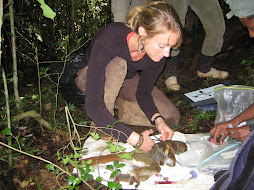
During the evaluation, I'll note a lot of information about the individual, such as age, sex, any abnormal behavior, and general coat, eye and teeth condition. I also take a small hair sample to later measure stress hormone levels in the lab, a fecal sample (mmmm....yes, my life is glamorous) to look at intestinal parasites and a small skin sample to get DNA from each individual.

All this data will come back to the US for analysis, and combined with geospatial and habitat data, we can tell a great deal about lemur health.

Saturday, June 14, 2008
T minus 0!
I'm sitting here, bags mostly packed, trying to send off a few words before I start my 36-hour journey to Madagascar. Sad, but excited, a little nervous....it will be an adventure.
I got all my stuff into 3 bags, not two. Perhaps the airline will take pity on me? Doubt it.
I got all my stuff into 3 bags, not two. Perhaps the airline will take pity on me? Doubt it.
Tuesday, June 10, 2008
Welcome to lemur health & conservation!
Thanks for joining me--I'll be posting this summer from the island of Madagascar. Please stay tuned for tales of dirt, lemurs, rice and beans from several remote field stations throughout the country.


Thursday, June 5, 2008
Where in the world?
Field research is far from glamorous. As the summer goes by, you'll see me picking up lemur poop, collecting lemur hair, pushing my way through dense dry forests and slogging through ankle-deep mud in the rain forests. And showers, you ask? Probably about every 3 weeks in the dry country, and every 30 minutes in the rain forests, whether I like it or not.
So why would I put myself through something like this? Well, I think wildlife health is an important issue (more on that later). But also, Madagascar is an absolutely amazing place. I'll try to share some of those fantastic moments from this summer through pictures and videos. And lucky for you, those glimpses will come without having to withstand my 3-week hiatus from bathing.
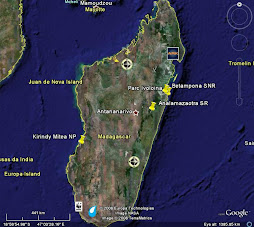
I'll work on both the west and east coasts of Madagascar this summer. Because I'm interested in how lemur health levels vary based on location, geography, climate and type of forests, I need to visit several parks throughout the country. I know, rough assignment. I'll spend a lot of time in Kirindy Mitea National Park (west), then in Betampona Strict Nature Reserve and Parc Ivoloina (east). Check out the map below!

So why would I put myself through something like this? Well, I think wildlife health is an important issue (more on that later). But also, Madagascar is an absolutely amazing place. I'll try to share some of those fantastic moments from this summer through pictures and videos. And lucky for you, those glimpses will come without having to withstand my 3-week hiatus from bathing.
I'll work on both the west and east coasts of Madagascar this summer. Because I'm interested in how lemur health levels vary based on location, geography, climate and type of forests, I need to visit several parks throughout the country. I know, rough assignment. I'll spend a lot of time in Kirindy Mitea National Park (west), then in Betampona Strict Nature Reserve and Parc Ivoloina (east). Check out the map below!

a few notes on me...

I came to Duke University's Program in Ecology in the fall of 2006, after working for a number of years on field research projects around the globe. What did snails in Tanzania, white-tailed deer in Minnesota, seabirds in Alaska, colobus monkeys in Equatorial Guinea and howler monkeys in Ecuador all have in common? They showed me that conservation efforts must consider wildlife health in order to be effective.
I also learned that global human health cannot ignore its connections with wildlife and ecosystem health, and that this interconnectedness will become more and more important as human populations grow. Armed with these ideas, I knew I wanted to work towards figuring out how conservation and public health can better approach the increasing interaction between humans and wildlife, which could lead to disease transfer. I hope my dissertation research on lemur health and human development in Madagascar will contribute to our knowledge of wildlife health and will guide us towards new policy options.
Subscribe to:
Posts (Atom)

.jpg)
.jpg)
.jpg)
.jpg)
.jpg)