Showing posts with label wildlife health. Show all posts

Sunday, June 15, 2008

What is a lemur health evaluation?

We can get very useful information from the lemurs when we have them in hand. For the larger lemurs, we need to capture them with a dart gun (more on that later), but for the smaller lemurs, such as mouse lemurs, we can use small traps that don't hurt the little guys. Put a little piece of banana in there and the mouse lemurs love it.


During the evaluation, I'll note a lot of information about the individual, such as age, sex, any abnormal behavior, and general coat, eye and teeth condition. I also take a small hair sample to later measure stress hormone levels in the lab, a fecal sample (mmmm....yes, my life is glamorous) to look at intestinal parasites and a small skin sample to get DNA from each individual.

All this data will come back to the US for analysis, and combined with geospatial and habitat data, we can tell a great deal about lemur health.

Thursday, June 5, 2008

a few notes on me...


I came to Duke University's Program in Ecology in the fall of 2006, after working for a number of years on field research projects around the globe. What did snails in Tanzania, white-tailed deer in Minnesota, seabirds in Alaska, colobus monkeys in Equatorial Guinea and howler monkeys in Ecuador all have in common? They showed me that conservation efforts must consider wildlife health in order to be effective.

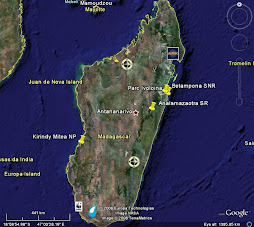
I also learned that global human health cannot ignore its connections with wildlife and ecosystem health, and that this interconnectedness will become more and more important as human populations grow. Armed with these ideas, I knew I wanted to work towards figuring out how conservation and public health can better approach the increasing interaction between humans and wildlife, which could lead to disease transfer. I hope my dissertation research on lemur health and human development in Madagascar will contribute to our knowledge of wildlife health and will guide us towards new policy options.