In honor of
Monday, July 7, 2008
To Independence!


Tuesday, July 1, 2008
Getting to know Kirindy Mitea...
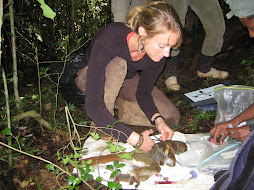
To test out methodology I set out 10 traps a few nights ago, and had some success on the first day! Meet our first subject, KM 001. A cute little guy, if I do say so myself.

Saturday, June 28, 2008
Maztoa a Kirindy Mitea!
A mere 6 days after I left North Carolina…and I arrive at my destination, Kirindy Mitea National Park. A glorious arrival. I was greeted by Dr. Rebecca Lewis, the founder of the research station here, and researcher on sifaka social behavior from the University of Texas-Austin. She’s worked in Madagascar for several years now, but only recently began working in this park. Starting a new research station means a lot of work and a lot of waiting—for permits, for water, for the process to work its way through the Malagasy system. With a lot of patience, she just recently established the gridded trail system and infrastructure for research at Kirindy Mitea. She gave me a tour of my new home, which is comfortable and beautiful, but didn’t take long to tour……see for yourself!
The camp is a colorful, friendly mix of researchers, camp staff, and a Malagasy student, which means 3 languages may be spoken at any one time (Malagasy, French, or English, in that order of frequency). We all eat our meals together, which generally consist of rice with roasted peanuts for breakfast, rice and beans for lunch, and rice and beans for dinner. We try to spice things up a bit and throw in a few new flavors every once in a while. The grated parmesan cheese I brought from the US was a hit, although it was met with some skepticism at first. You mean…….cheese……….as a powder? After some inspection and a little smelling, the staff tasted it. “Tsara,” they replied, which means “good” in Malagasy!

(Top L-R) Tagloire (cook), Vagely (trail maintenance), Dr. Chris Kirk (Physical Anthropologist).
(Bottom L-R) Renari (driver & mechanic), Felana Rakotondranaivo (Malagasy master’s student), Dessy (camp manager), Dr. Rebecca Lewis (camp founder, Primate Social Behavior).
The Lepilemur sing us to sleep and the fosa keep us on our toes--I’m really going to enjoy living here!
Wednesday, June 25, 2008
Public transport, Mada-style.
Of course, if this 4x4 thing doesn’t work out, I always have another option for transportation.
Introduce: The charrette, the local transportation of choice.
Kirindy Mitea or Bust!
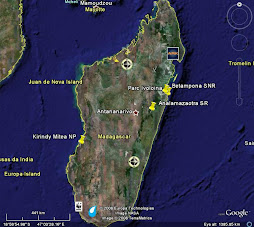
Getting to Kirindy Mitea National Park is no easy feat—in fact, it’s virtually impossible by road for most of the year. Over the 70 or so miles from Morondova, there are several river and water hole crossings only passable in the dry season. Be careful if you try a bit too early—your car may wash downstream into the Mozambique Channel. Visitors and researchers will often take a motorized pirogue (wooden canoe) down to a coastal town, Belo-sur-Mer, and then walk to the park. We’ll try that later this summer, but for now we’re cruising in the 4x4.
I’m excited to reach Kirindy Mitea and see what it will be like—I’ve spent many months wondering about this moment. Onward to the river!
Tuesday, June 24, 2008
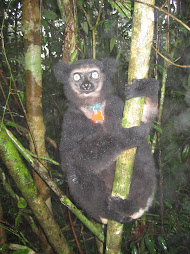
Indri indri? Call for you!
Click to hear the eerily beautiful call of the Indri. Groups of Indri use this call to communicate and demarcate their territory.
To learn more about this gentle giants, read here.
Sunday, June 22, 2008
Catch a falling star
People often ask just how exactly we go about catching a lemur, so I thought I might share this little video and describe the process.
The capture team, made up of a darter, a couple of spotters and 4-5 people designated as runners, walks slowly through the forest. If a lemur is spotted, the darter waits and maneuvers to get the perfect shot. The dart gun, pressurized with carbon dioxide, is fairly accurate, but you usually only get 1 chance before the lemur is long gone. No accidents here either.....in over 450 lemur captures, the Prosimian Biomedical Survey Project has not had a single lemur injury.
 If the dart successfully hits the lemur (it's best in the meaty rump!) the team watches to see the lemur's reaction. I've seen some lemurs take off and cover 300 horizontal feet through the forest in a matter of seconds. Other lemurs, such as the Indri, gaze down and wonder peacefully what has transpired. In either case, the runners of the team position themselves under the lemur and....wait. And in some cases, we wait and wait and wait. I've seen an Indri take over an hour and a half to go under the anesthesia, but some will take just 10 minutes. See our neck muscles of steel in the picture above.
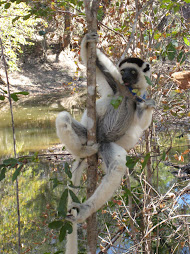
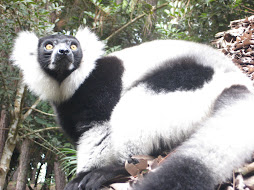
When the lemur is ready, it's grip will slip on the tree branch and we are there to catch it. This was a million dollar catch of a black-and-white-ruffed lemur from almost 100 feet up. Gol!
At this point the lemur health evaluation process begins, which takes about 40 minutes. We'll hold the lemurs (and sometimes keep them warm under our jackets) until they've fully recovered. Then they're released to their original location.
Thursday, June 19, 2008
Morondova--last stop before Kirindy Mitea National Park
Greetings from Morondova, gateway to the Baobabs! I flew in yesterday morning early on a small D60 plane, with propellers and all. There wasn’t a safety presentation, but needless to say, for once in my life I read through the safety card thoroughly, cover to cover. But all was well, even when the pilot got the plane steadied at our cruising altitude and started reading the daily paper. Such is life here….
I love Morondova—it’s a bustling, friendly town on the shores of the Mozambique Channel, a mere 300-400 kilometers from the African continent. I head down to Nosy Kely, the strip of land that juts out into the channel for dinners, where I can watch the sunset on the beach, eat lots of fresh seafood, and sip Malagasy rum flavored with lychee (there are perks to fieldwork). I watched a local woman come into a restaurant last night carrying freshly caught langostines, or lobsters. They were gorgeous, with bright blue, yellow and red coloring. 
I’m getting all my supplies (i.e., toilet paper and chocolate) ready to head out for my first stint of field work. I’ll be in Kirindy Mitea National Park from tomorrow until the 4th of July, with a possible break on the 25th and 26th of June to come back to Morondova to take part in Madagascar’s Independence day festivities. I’m sure it will be a party! I’ll send stories from the field when I get back….wish me luck with the ol’ mouse lemurs.
Wednesday, June 18, 2008
Tana: the land of rice and taxis
Tana is fairly spread out, so it’s best to take a taxi if you need to go to the downtown area. I love walking around the city, checking out different streets along the way, but I think saving my lungs from sucking down fumes will be worth it in the long run. The town is overrun with taxis so you never have to wait long. And no taxi ride is the same—on several of them now my driver has asked for my fare early so that he could fill up with just enough gas to get to our destination. That usually ends up being about 2000 Ariary, or about a $1.30. Gas (or l’essence, as I’m learning) is pricey here—about $8 - $10 a gallon, which makes our $4 a gallon hike in the US seem measly. Most of the taxi drivers have taken to popping their old puttering Peugots into neutral down the steep hills of town to save gas. Never a dull moment, I tell you.
Last night I met 3 American researchers on a countrywide quest to find the blind, un-pigmented, cave-dwelling fish that live only in Madagascar. I felt rather run of the mill with my lemurs!
Tuesday, June 17, 2008
Landed in Tana!

I'm here in Tana for a few days to arrange for all of my required permits and my extendable visa. Madagascar has a fairly serious permitting process, with a full application and review process that takes about 3 months, so researchers have to apply far ahead of time. The process is facilitated by MICET, an organization that supports and coordinates visiting researchers throughout Madagascar. Each foreign visitor that does work in the country also sponsors a Malagasy student. I met my assigned student today, a master’s student named Herman. He’s interested in comparing the feeding preferences of mouse lemurs in the dry and wet forests, which will fit in nicely with my project. We did pretty well with our communication, although my bad French and his limited English will be an interesting combination.
Photo: Steve Evans, 2005, Wikipedia

.jpg)
.jpg)
.jpg)
.jpg)
.jpg)
