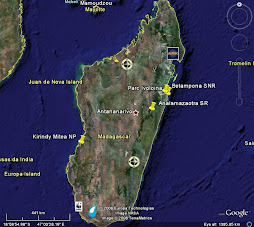
We assess the health of lemurs exposed to human disturbance in protected areas throughout Madagascar. After conducting our health evaluation, we release the lemurs--unharmed--back into their natural habitat. Check out one of our mouse lemur visitors getting back into the swing of things.
Wednesday, January 28, 2009


Monday, October 13, 2008
Back to the grindstone....
 Prepared October 13, 2008
Well, I made it back to the
Thanks to anyone who kept up with my activities this summer—I really appreciate your interest! I’ll be heading back to  That means Indri, so if you’re interested in their teddy-bear looks and unique,
Cheers,
Meredith
A little time for exploring…..

Prepared September 17, 2008
Secret of our success
Prepared September 7, 2008

Taste the rainbow....a food montage
As food structures the day around here, I thought I would share with you what a typical day in the life of food at Kirindy Mitea is like.
Breakfast, 
Lunch, 

It’s hard to forget. I’ve found that with ample amounts of garlic powder, parmesan cheese and
Friday, October 3, 2008
Microcebus Super-Sleuths
Prepared
It seems as though there are new Microcebus species popping up every week….what once had been defined as an eastern and a western species now has been amended to include several species. This has caused some ongoing controversy as scientists debate which species should be considered separate and which should not. But the DNA will tell the tale—that’s why we’re sure to collect small samples of skin to use for genetic analyses. In addition to this data, we’re also noting all the variations in color and size that we see in the mouse lemurs. Armed with this combination of information, we hope to figure out the complex mystery that is mouse lemur speciation in
Wednesday, October 1, 2008
Boom & Bust
 I don’t know if field work attracts gambling personalities, but it sure seems like that would be helpful to deal with the constant unknown of capture—so much is out of your control. It’s like I buy a Keno ticket every night when we put out our traps, and sometimes our numbers come up. That’s just one of things that keeps life interesting around here. If only I could make money doing this! Just to give you an example of how unpredictable capture can be—in one week we had a few days in a row of no mouse lemurs captured—0 (see my disappointment in the photo to the right). Then the next day we were overrun with mouse lemurs, capturing 10 in one of the grids (see jubilation below). I think they just like to keep us guessing.

Tuesday, September 30, 2008
Kirindy Mitea turns 10 and has a growth spurt
Prepared August 30, 2008
To counteract the gloomy message of the last entry, I’m going to share with you some great  news. Within the last year, the Malagasy government and its park management agency, Association Nationale pour la Gestion des Aires Protégées (ANGAP), decided to expand the size of
Sunday, September 28, 2008
Cows and dogs and rats, oh my!
Prepared August 29, 2008
Mouse lemurs aren’t the only animals that I’m concerned about out here. Expanding human populations, which push the boundary into preserved areas for resource extraction, hunting, subsistence agriculture and cattle grazing, could lead to potentially huge impacts on the conservation and health of wildlife populations. Where humans go, their domesticated animals typically follow, and where domestic animals go, their parasites are sure to tag along. We can simply look to human history to see the implications of animal domestication. One of the major transitions in lifestyle occurred about 10,000 years ago as agriculture developed. By producing our own food and domesticating animals, humans were able to rapidly increase their populations, and began to live in denser aggregations like towns and cities.  This increased density, along with the mixing of multiple species (humans and livestock) in a small area lead to an upsurgence of disease. Over 600 known parasites occur in domesticated animals, and over 60% of the over1400 parasites found in humans have come from a domestic animal origin. To make matters worse, all of these densely packed people and livestock attract another player into this equation—rodents. And as we all have learned from the 14th century’s Black Death, rodents are exceptional couriers of disease. Unfortunately, all of these issues are important to consider for conservation in
 Villages on the edge of reserves raise and graze their cattle through preserved areas, their dogs and cats wander through, and even humans leave their waste in the reserves. Additionally, the black rat (Rattus rattus) has expanded to cover the entire island since its accidental introduction in
Friday, September 26, 2008
Prepared August 25, 2008
Lepilemurs sneak into my dreams at night. It’s not hard, what with their loud, Iwok-sounding calls back and forth filling the forest night air. These nocturnal “sportive” lemurs are a delight to experience. As I brush my teeth, I shine my headlamp through the tops of the trees, looking for their distinctive marble-sized eyes staring back at me. They rest in hollows of trees during the day, saving up their energy to generate an auditory spectacle at night.  I have other visitors at night as well—the legendary and elusive Fossa (Cryptoprocta ferox) comes by my tent at night every few days. A pair of them roams the camp looking for water and goodies, and they also have an insatiable curiosity. They will paw through my campsite at night, poking my tent just to figure out what it is. I sit bolt upright in my sleeping bag, thinking about the sheer millimeter of tent material that separates me from Madagascar’s largest carnivore…..But when my headlamp comes on and I give the tent a shake, the fossas are out of there. Or at least that’s what I keep hoping. Keeps you on your toes.
And an update: Well, the fossa did not stay quite so docile this time. Apparently he likes my shoes, or my feet smell like lemurs, because he chewed some nice chunks out of my sandals. A good souvenier story, right?
Thursday, September 25, 2008
Implements of Science
Prepared August 24, 2008
 Just thought I’d share the implements that I use in my research out here….tubes for collecting genetic and fecal samples, a scale, a thermometer, the applicator for the identification ear tags, the skin fat calipers (I avoid using them on me!), bag to safely house the mouse lemurs during the day, and a flexible measuring tape to get measurements on mouse lemur body length, tail length, and yes, testicle size. That you didn’t really want to know, right?
Tuesday, September 23, 2008
Eat. Sleep. Breathe. Mouse lemurs. Eat. Sleep. Breathe. Mouse lemurs.
 into a routine, a rhythm of the field. It can get monotonous, but it also feels kind of nice. A relaxed pace that allows you to get lots of work done out here. A typical daily schedule is something like this: early to rise at 6 am, breakfast, go out and check traps for mouse lemurs, health evaluations of mouse lemurs, lunch at noon, data processing, set traps in the late afternoon when it’s cooler, return mouse lemurs at dusk, eat dinner by candlelight, read by headlamp, sleep (9 hours at night!). Whew. Ready to do it all again tomorrow? Embrace the routine—it’s an even, steady roll that’s a satisfying change from our manic everyday lives in the States.
Sunday, September 21, 2008
 We had 24 kilometers to cover to
Get off the road--I even got to try my hand at navigating for a while!

Saturday, September 20, 2008
Fete to get a boat wet
Prepared August 15, 2008
 This construction may satisfy a number of firsts for this village—the first boat built by a white person, and most likely the first built by a woman. Well, to celebrate such an occasion, the entire village came out in full force. A sound system that would have made Aerosmith proud appeared out of nowhere (the villagers definitely don’t rock out every night in their huts) and set up on a stage in the sand, not 30 feet from the water. Every official of import came out in suit and tie to make the requisite kibari (speech). The music (a live band had traveled from Tana to make the party a success) started at sundown and literally went until the next morning. As we walked out of Belo the next morning at
Friday, September 19, 2008
Eastern mouse lemurs came through
 After a slow start at Parc Ivoloina, we finished up at Betampona with a total of 28 Microcebus captures, which I was pleased about. We had only 1 or 2 days without a single capture, and some of our days were chalk full with as many as 6 mouse lemurs. It worked out well, and our hard work slogging through the mud, pulling ourselves up steep slopes and defending our skin against leeches paid off. Thanks to all of the conservation agents of the Madagascar Fauna Group project and their families for all the help they offered. It really does take a village (to capture mouse lemurs).
 And at the end of the day, a scientist has to be satisfied with the seemingly small specimen bags and tubes that she or he will go home with. It doesn’t look like a whole lot, but the amount of information stored in those small packages will hopefully be interesting and worthwhile.
Photo credit: Patrick H
Wednesday, September 17, 2008
Releasing a wild beast (or something like that)
 Believe me, it’s not nearly as exciting as that sounds. After the day relaxing in their comfortable, Malagasy-style bags, these mouse lemurs are excited to get back to their home turf. At dusk we release them at their original location of capture, which is extremely important to do because mouse lemurs can be very territorial. If we released a lemur into the wrong territory, it could mean serious consequences. Mouse lemurs can be quite fierce, you know.
With just a little encouragement out of the bag, the mouse lemurs are springing forth back into their familiar trees, ready for a night of activity. Check out the release of one of our mouse lemurs at Betampona…….
Sunday, September 14, 2008
Fermenting gooey goodness. All in the name of science.
When we’re in a remote field station, that means deliveries and resupplies are a bit out of the question. That applies not only to our rice and beans, but to our mouse lemur bait as well. We use bananas because the mouse lemurs love ‘em, and apparently they may love ‘em even more as they rot, become mushy and begin to ferment in the skin.  As the last days of our trapping roll around, the bananas have been sitting for a good amount of time and they are becoming almost unbearable to our senses. It’s just pure delight setting up all the traps and dropping a piece of that liquidy banana into the trap.
 But we continued to capture mouse lemurs up until the very last day with those odoriferous fruits. I almost think the mouse lemurs wait until the bananas hit this ultra-ripe stage—what animal doesn’t partake in a little fermented fruit juice?
 As the last days of our trapping roll around, the bananas have been sitting for a good amount of time and they are becoming almost unbearable to our senses. It’s just pure delight setting up all the traps and dropping a piece of that liquidy banana into the trap.
 But we continued to capture mouse lemurs up until the very last day with those odoriferous fruits. I almost think the mouse lemurs wait until the bananas hit this ultra-ripe stage—what animal doesn’t partake in a little fermented fruit juice?
Thursday, September 11, 2008
The Malagasy experience is much more than mouse lemurs
 A few days ago we received an invitation from our Rendrirendry villagemates--they were about to host a ceremony in the nearby village of Andratambe. We were grateful to be included in the celebration, an important event that involves family and community remembering and honoring the deceased. This particular celebration did not involve exhuming and moving of the bodies, or the “rotating of the bones,” or famadihana, which occurs in another typical Malagasy custom, but it did involve one heck of a party and a whole lot of cow. Villagers up here on the mountain live primarily on rice, beans and some vegetables such as manioc and greens, therefore eating beef (omby), is a rare and important occasion. A cow was purchased and brought up the mountain to the center of the village, where nearly every man, woman and child from the surrounding areas had gathered. (….stop reading here if squeamish…..) It was immobilized and left in the center of the village as the main attraction for a good while. Then suddenly a few men ran out and quickly ended the cow’s life there in the center of town under a couple hundred watchful eyes. Words to the dead were discreetly presented, much betsa and toka gasy (locally-produced sugar cane alcohol) was poured, and the distribution of the cow commenced. About 30 men gathered round the cow and worked together to begin the cutting process, placing each smaller piece on a large traveler palm leaf on the ground. We watched as this huge cow was slowly but surely cut into smaller and smaller pieces, enough so that the entire village was able to take some home for their family for the next several days. I’ve never witnessed a more local, more community-based sharing of a resource before, and I may never again.
Monday, September 8, 2008
Meet Bethany from Mahabo, volunteer extraordinaire
09I certainly got lucky this summer—a Peace Corps volunteer who’s working in Madagascar emailed me out of the blue to see if I could use some help with my field work. She’s teaching English in a small village east of Morondova and had some flexibility in her summer schedule. I wasn’t quite sure what an English major (Duke graduate no less!) would think about all this tromping through the woods, chasing small primates. But she’s been fantastic—a huge help and a saving grace for my mental stability in the field. We’ll look forward to an entry from her later on this summer—she’ll tell us in her own words what it’s like to work with an ecologist in the field. But to tide us over until then, here’s a little video introduction……
Friday, September 5, 2008
Aww, mouse lemur's first haircut.
You can get a lot of information from a capture, so we really try to maximize the time that the mouse lemur has so generously donated to us. One of the samples that we take is a small cut of hair to evaluate long-term environmental stress. This is a fairly new technique in hormone analysis that will hopefully be able to show us the residual stress hormone levels (glucocorticoids) in the mouse lemur’s body over a long period of time. In many previous studies, researchers have successfully evaluated stress hormone levels in fecal or blood samples, which provide a picture of stress from the previous day or hours, respectively, but with hair one can evaluate stress on a longer scale, on the time frame of several months. That’s what I’m really interested in—how long-term environmental stress affects wildlife and may compromise their ability to deal with human exposure and increased rates of parasitism.
Subscribe to:
Posts (Atom)